
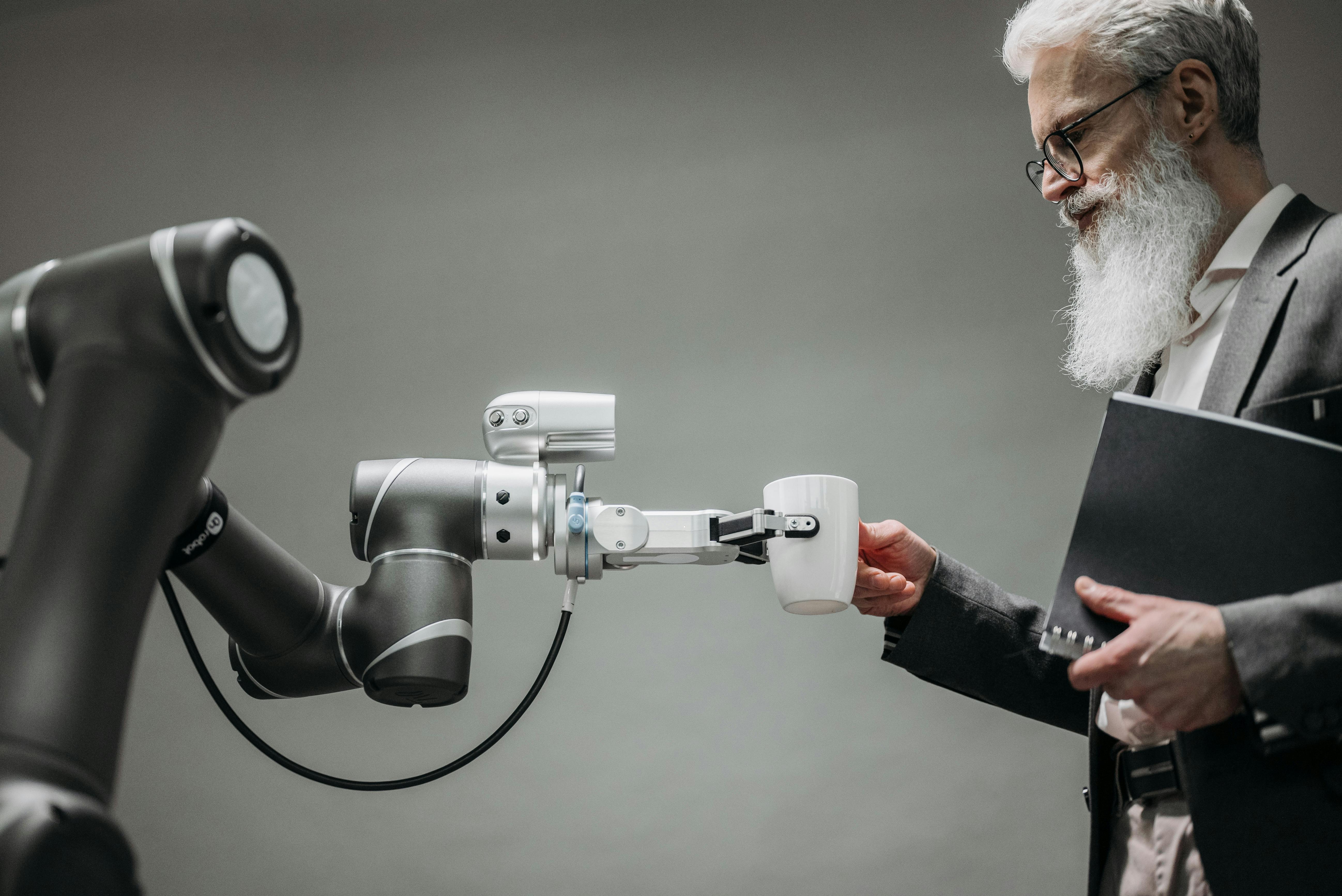
What Are Autonomous AI Agents?
An autonomous AI agent is a large language model (LLM) or multi-model AI system augmented with the ability to take actions in the world — browsing the web, writing and executing code, sending API requests, and interacting with software systems — based on a high-level goal provided by an operator. Unlike a human typing prompts into ChatGPT, an agentic system can execute hundreds of sequential steps without human input, making decisions, course-correcting based on results, and pursuing its objective with single-minded persistence.
The rapid commoditisation of agentic AI frameworks — OpenAI's Operator, Anthropic's computer use API, AutoGPT derivatives, and numerous open-source alternatives — has dramatically lowered the barrier for malicious actors to deploy these capabilities for offensive purposes.
The First Wave: What Researchers Have Documented
In Q1 2026, multiple security research firms published findings documenting real-world instances of AI-orchestrated attacks. The key findings paint a concerning picture:
Automated Vulnerability Discovery and Exploitation
Researchers at Palo Alto Networks Unit 42 and Google Project Zero independently documented cases where AI agents were used to discover and exploit vulnerabilities in web applications at a scale and speed previously impossible with human operators. In one case study, an AI agent systematically tested a target web application across 47 different attack vectors in under six minutes, successfully identifying and exploiting a SQL injection vulnerability, extracting a database schema, and staging data for exfiltration — all before any human monitoring system had generated an alert.
Spear-Phishing at Unprecedented Scale
Traditional spear-phishing required significant human research effort to craft convincing, personalised emails. AI agents eliminate this bottleneck entirely. Researchers documented campaigns where AI agents were tasked with harvesting LinkedIn profiles, cross-referencing with public breach data, crafting individually tailored phishing emails referencing real details about each target's role and recent activities, and iteratively refining the approach based on click-rate feedback — all autonomously. In documented campaigns, AI-crafted spear-phishing achieved click rates 3x higher than traditional bulk phishing, while requiring minimal human oversight after initial deployment.
Adaptive Lateral Movement
Perhaps most alarmingly, researchers documented AI agents performing adaptive lateral movement inside compromised networks. Unlike traditional automated attack tools that follow scripted playbooks, these agents observed the network environment, identified high-value targets, selected appropriate attack techniques based on available credentials and services, and modified their behaviour when specific techniques failed — mimicking the adaptive decision-making previously requiring a skilled human operator.
The Economics of AI-Powered Attacks
To understand why this shift is so significant, consider the economics. A skilled human penetration tester can conduct a comprehensive network assessment in 2-4 weeks. An AI agent, with appropriate tooling and access, can perform equivalent reconnaissance and initial exploitation phases in hours, at a fraction of the cost, and can run continuously across multiple targets simultaneously.
For criminal organisations, this changes the attack economics fundamentally. The marginal cost of targeting an additional organisation approaches zero when an AI agent can be tasked with opportunistic reconnaissance and initial access across thousands of targets simultaneously. This commoditisation of attack capability means that sophisticated attacks — previously the domain of well-resourced APT groups and skilled criminal organisations — are becoming accessible to low-skill actors willing to pay a modest subscription fee.
What This Means for Australian Businesses
The implications for Australian organisations are significant and immediate:
Detection Methods Are Increasingly Obsolete
AI agents can be instructed to mimic legitimate user behaviour patterns, move slowly to avoid triggering velocity-based detection rules, randomise their actions to defeat pattern-matching, and vary their tooling to avoid signature-based detection. Many Australian organisations' security monitoring is calibrated to detect human-speed attacks and known attack signatures. AI-agent attacks operating at low-and-slow speeds with novel techniques will bypass many existing controls.
The Attack Surface Has Expanded
AI agents are particularly effective at exploiting the long tail of vulnerabilities — the forgotten server running an outdated CMS, the misconfigured S3 bucket, the developer credentials accidentally committed to a public GitHub repository. These lower-priority vulnerabilities that your security team never gets around to remediating are precisely what AI-orchestrated reconnaissance is most effective at identifying and exploiting at scale.
Social Engineering Has Reached New Heights
AI-generated phishing content is now indistinguishable from legitimate correspondence. Combined with voice cloning and deepfake technology, AI-powered social engineering attacks can convincingly impersonate executives, IT staff, and trusted vendors. Traditional security awareness training that teaches staff to look for grammatical errors and suspicious formatting is no longer sufficient.
Defensive Strategies for the Agentic Attack Era
Defending against AI-orchestrated attacks requires a fundamental shift in approach. Security leaders should consider the following:
Zero Trust as Table Stakes
Assume breach and implement microsegmentation. An AI agent that gains initial access to one system should be unable to pivot laterally without encountering additional authentication and authorisation challenges. Zero Trust Architecture is the single most effective control against autonomous lateral movement.
AI-Powered Defence
The defence must meet the attack at its own level. AI-powered security operations platforms that can detect anomalous behaviour patterns in real-time, across large datasets, and at machine speed are now essential — not aspirational. Human-only security operations teams operating at human speed cannot keep pace with AI-orchestrated attacks.
Attack Surface Management
Eliminate the targets AI agents are most effective at exploiting: unpatched systems, forgotten assets, misconfigured cloud resources, exposed credentials. Continuous automated attack surface management and vulnerability scanning should be treated as critical infrastructure, not an optional add-on.
Deception Technology
Honeypots, canary tokens, and deception grids are highly effective against AI agents because they create noise that distracts and detects automated probing. An AI agent following an exploration strategy will often trigger deception assets that a targeted human attacker might avoid.
Rethink Security Awareness Training
The focus needs to shift from "identify suspicious emails" to "verify all requests through an out-of-band channel before taking action involving credentials, payments, or sensitive data." Phone verification, in-person confirmation, and multi-party authorisation for sensitive actions provide controls that social engineering — whether human or AI — cannot easily bypass.
The Regulatory Dimension
Australia's evolving cyber security regulatory framework has not yet directly addressed agentic AI threats. However, the mandatory incident reporting provisions of the Security of Critical Infrastructure Act and the updated Cyber Security Act 2026 create a reporting obligation for organisations that experience AI-orchestrated attacks that meet the threshold criteria.
We anticipate that the ASD will release updated guidance on AI-specific threat mitigations in H2 2026, in alignment with parallel guidance being developed by CISA, NCSC, and ENISA. Organisations in critical infrastructure sectors should begin engaging with the ASD now to understand their obligations and develop appropriate response frameworks.
CyberSec.au Assessment
The emergence of autonomous AI agents as a viable attack platform is the most significant shift in the threat landscape since the commoditisation of ransomware-as-a-service. Unlike ransomware, which primarily represents a financial threat, AI-orchestrated attacks create exposure across every threat category — espionage, sabotage, data theft, and financial fraud — and do so with a speed and scale that overwhelms traditional human-paced security operations.
Australian organisations that have not yet invested in AI-powered detection capabilities, Zero Trust architecture, and continuous attack surface management are operating with an increasingly dangerous security debt. The window for proactive remediation is narrowing. The question is no longer whether autonomous AI agents will be used against Australian organisations — it is whether Australian organisations will be ready when they are.
Is Your Security Posture Ready for AI-Powered Threats?
Get a comprehensive assessment of your defences against next-generation attack techniques including AI-orchestrated attacks.
Start Free Security Assessment